Claude Opus 5 Benchmarks: Fable 5 Performance at Half the Cost
Claude Opus 5 Benchmarks: Fable 5 Performance at Half the Cost
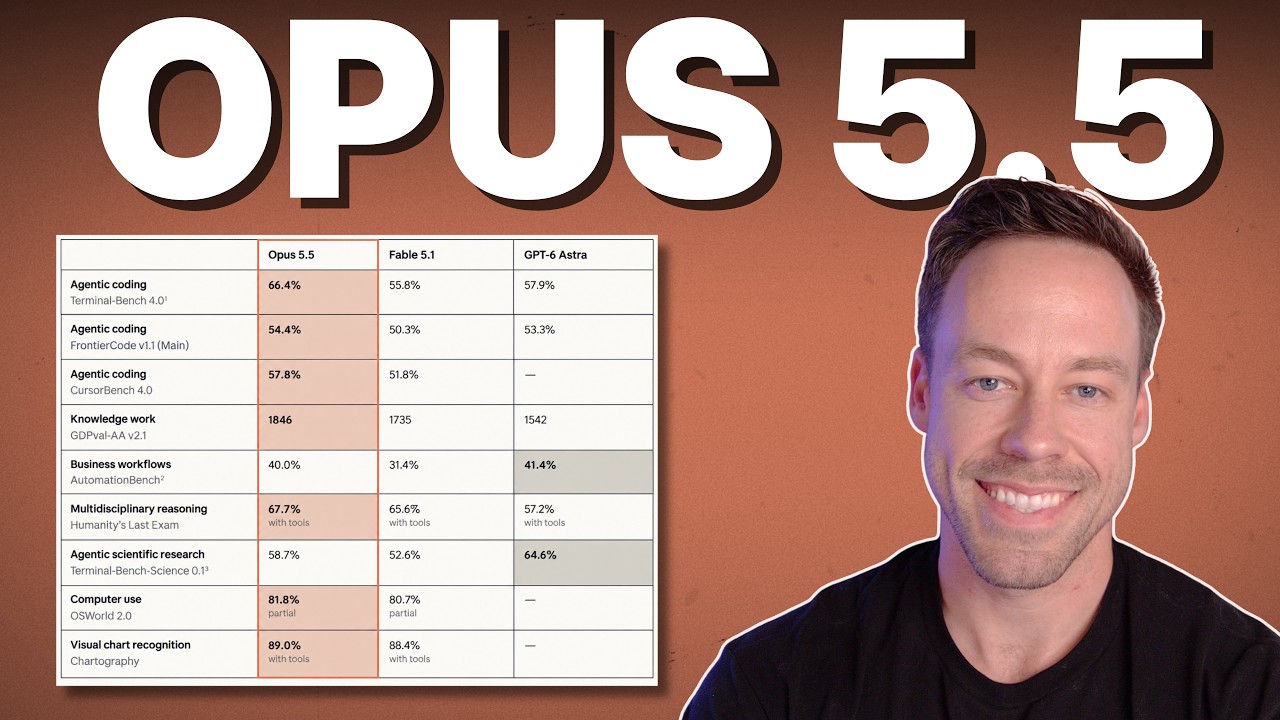
Claude Opus 5 gets you within striking distance of Fable 5's outputs for roughly half the price — $5 per million input tokens and $25 per million output, versus Fable's numbers that are twice that. That's the headline, and after reading through Anthropic's benchmark charts, the claim mostly holds up. The bigger story isn't even the Fable comparison. It's how far Opus 5 jumps over Opus 4.8.
I've been building agentic systems with Claude for a while now, and the gap between model generations is usually incremental. This one isn't. Here's what actually matters in the Opus 5 release and where it changes how you should be building.
How Does Opus 5 Compare to Fable 5?
The short answer: on most benchmarks, Opus 5 either matches or beats Fable 5 — and it does it cheaper. That's the part I can't get over.
Anthropic's charts show Opus 5 beating Fable 5 outright on agentic terminal coding, knowledge work, and agentic search. In those same categories it's also beating GPT's 5.6 soul. The only spots where Opus 5 trails Fable 5 are multidisciplinary reasoning — and even there it's a hair, and it pulls ahead once it's allowed to use tools — plus legal and health.
The clearest data point is Cursor Bench 3.2. At max effort, Opus 5 performed within 0.5% of Fable 5's peak score, but at half the cost per task. That's the whole pitch in one line. On the artificial analysis coding agent index, Opus 5 doesn't just get close — it straight up beats Fable 5. Same on the frontier bench: it's outscoring Fable and it's cheaper.
There's one honest caveat in the charts. At absolute max max effort, Fable 5 does pull ahead. But most people aren't running at max — they're at high or extra high. And at those settings, Opus 5 is producing effectively the same outputs as Fable for half the money.
Why Is the Jump From Opus 4.8 to Opus 5 the Real Story?
Everyone's going to fixate on the Fable comparison. But the more useful number is the leap from the previous Claude generation. Across the board, Opus 4.8 to Opus 5 is a massive step up — not a polish pass, a genuine generational jump on nearly every knowledge-work and problem-solving benchmark shown.
Here's why that matters more than the Fable headline: if you're already building on Claude, you're not choosing between vendors. You're getting a substantially better model at lower cost than the one you were already paying for. That basically never happens. Usually the better model is the more expensive one.
Contrast that with Sonnet 5, which — when you break cost down per task — is somehow the most expensive model out there. Opus 5 goes the other direction. It looks extremely token-efficient compared to both Sonnet 5 and Fable 5, which is a big part of why the per-task cost lands so low.
What Got Better in Opus 5?
Three concrete improvements stand out beyond the raw benchmark bars.
Visual output. Claude still can't generate its own images — that's a known limitation. But Opus 5 is noticeably better at the visual work it can do: 3D-created SVG and HTML-style graphics. Anthropic showed it doing wind tunnel simulations and building a 3D interactive animal cell artifact. If you're using Claude to produce diagrams, interactive visualizations, or code-generated graphics, this is a real upgrade.
Self-verification on long-horizon tasks. This is the one I care about most. Anthropic says Opus 5 is much stronger at verifying its own work and iterating carefully until it succeeds. In plain terms: on tasks that aren't one-shot — loops where the model checks its output against a goal and keeps going until it hits the target — Opus 5 is far better than 4.8.
Safeguards that don't get in your way. Opus 5's guardrails are less trigger-happy than Fable 5's. This isn't a scenario where mentioning cybersecurity or biology gets your request shut down. Anthropic says the classifiers are 85% less likely to trigger versus Fable, while still being present.
Why Does Long-Horizon Agentic Work Matter So Much?
Because that's where the actual value of an agent lives. Most people are still using these models for one-shot answers. The leverage is in the loops.
Think about what "checks its work against a goal and keeps iterating" really enables. You give the model a north star, not a step-by-step recipe, and it figures out the path itself. Anthropic's example is the best illustration of this I've seen.
Opus 5 was given a drawing of a machine part and told to write code to rebuild it as a 3D FreeCAD model — but it was never given a way to actually view the drawing. It wasn't told how to solve this. So it wrote its own computer vision pipeline to pull the geometry out of the raw pixels, then reconstructed the entire machine part from that.
Read that again. It wasn't handed a vision tool. It recognized it needed one, built one, and used it to hit the goal. That's the difference between a model that answers questions and a model that completes objectives. For anyone building agentic loops — the whole "graph engineering" pattern people are talking about — this is exactly the capability that makes those loops actually converge instead of spinning.
Is Opus 5 Safer or Riskier Than Previous Models?
On alignment, it's a step above. On the misaligned-behavior benchmarks — where lower is better — Opus 5 scores below all the previous models. That's the direction you want.
There's a flip side worth naming honestly. Opus 5 shows a large increase in capability to find vulnerabilities and exploits in open source code compared to Opus 4.8. That's a genuinely useful defensive tool if you're auditing your own codebase — and it's the kind of capability that cuts both ways, which is presumably why Anthropic pairs it with the alignment improvements.
What Does Opus 5 Cost?
Half of Fable, and that's the whole point. Opus 5 runs $5 per million input tokens and $25 per million output tokens. Combine that pricing with the token efficiency the benchmarks showed, and the real per-task cost drops even further below the sticker comparison.
So here's where it nets out: if the numbers Anthropic published hold up in real use, you're getting something that behaves like a slightly-better Fable 5 for half the cost — plus a huge jump over the Opus model you were already running. I'm genuinely excited to put this one through real work, because on paper it's the rare release where the better model is also the cheaper one.
Frequently Asked Questions
How much cheaper is Opus 5 than Fable 5?
Opus 5 costs roughly half as much as Fable 5 — $5 per million input tokens and $25 per million output tokens. Because Opus 5 is also more token-efficient per task, the real-world cost gap is often even wider than the raw pricing suggests.
Does Opus 5 actually beat Fable 5 on benchmarks?
On most of them, yes. Opus 5 beats Fable 5 on agentic terminal coding, knowledge work, agentic search, the artificial analysis coding agent index, and the frontier bench. It only trails on multidisciplinary reasoning (barely, and it wins with tools), legal, and health. At absolute max effort Fable 5 pulls slightly ahead, but at the high and extra-high settings most people actually use, they're roughly even.
What's the biggest improvement from Opus 4.8 to Opus 5?
The across-the-board benchmark jump is huge, but the most practically important change is self-verification on long-horizon agentic tasks. Opus 5 is much better at checking its work against a goal and iterating until it succeeds, which is exactly what agentic loops need to converge reliably.
Can Claude Opus 5 generate images?
No. Claude still can't create its own images. What improved is code-generated visual output — 3D SVG and HTML-style graphics — where Opus 5 is noticeably stronger, as shown by its wind tunnel simulations and a 3D interactive animal cell artifact.
Are Opus 5's safety guardrails less restrictive?
Yes, but in a controlled way. Anthropic says the safety classifiers are 85% less likely to trigger versus Fable 5, so topics like cybersecurity and biology don't get shut down as aggressively — while the guardrails still exist. At the same time, Opus 5 scores better on misaligned-behavior benchmarks than every previous model.
If you want to go deeper into building with Claude and agentic AI, join the free Chase AI community for templates, prompts, and live breakdowns. And if you're serious about building with AI, check out the paid community, Chase AI+, for hands-on guidance on how to make money with AI.