Fable 5.1: Better Benchmarks, 25% Lower Cost
Fable 5.1: Better Benchmarks, 25% Lower Cost
Fable 5.1 is here, and the short version is this: it beats Fable 5, Opus 5, and GPT 5.6 Soul on basically every benchmark while costing an estimated 25% less — and up to 45% less if you do heavy, long-running agentic work. I've been hands-on with Fable 5 since it dropped, and this is the rare upgrade that's both better and cheaper. Here's exactly what changed, where the real savings come from, and how to get frontier-level output without paying frontier prices.
What Is Fable 5.1 and Why Does It Matter?
Fable 5.1 is the incremental-but-meaningful successor to Fable 5. On paper it's a point release. In practice, the combination of higher benchmark scores, a 25% price cut, and looser safety guardrails makes it feel like a genuine step up when you're actually using it day to day.
Three things changed that matter to you:
- Price dropped — an estimated 25% cheaper on normal tasks, up to 45% cheaper on agentic workloads.
- Benchmarks went up — it beats Fable 5, Opus 5, and GPT 5.6 Soul across the board.
- Guardrails got more precise — 60% fewer false-positive interventions, especially on cybersecurity questions.
The headline that matters most: the per-token price didn't change, but your actual bill will. More on why below.
Why Is Fable 5.1 Cheaper Than Fable 5?
The sticker price per token is identical to Fable 5: $10 per million input tokens and $50 per million output tokens. So where does the savings come from?
Cache reads. Fable 5.1 makes cache reads cost 75% less, and that's the entire story behind the lower bill. If you don't know what prompt caching is, the simple version is this: when you reuse the same context across many calls — a long agentic session where you're talking to the model continuously instead of one-and-done — the model reads a lot of cached tokens. Those reads just got a lot cheaper.
That's why the savings scale with how you work:
- Normal tasks — roughly 25% cheaper.
- Highly agentic workloads — up to 45% cheaper, in cases with thousands and thousands of tokens and context windows running at 50, 60, 70% full.
If you spin up large sessions, keep them alive, and keep talking to the model rather than coming back the next day, this is a big deal. The cost reduction can't be overstated for that use case.
How Do the Fable 5.1 Benchmarks Compare?
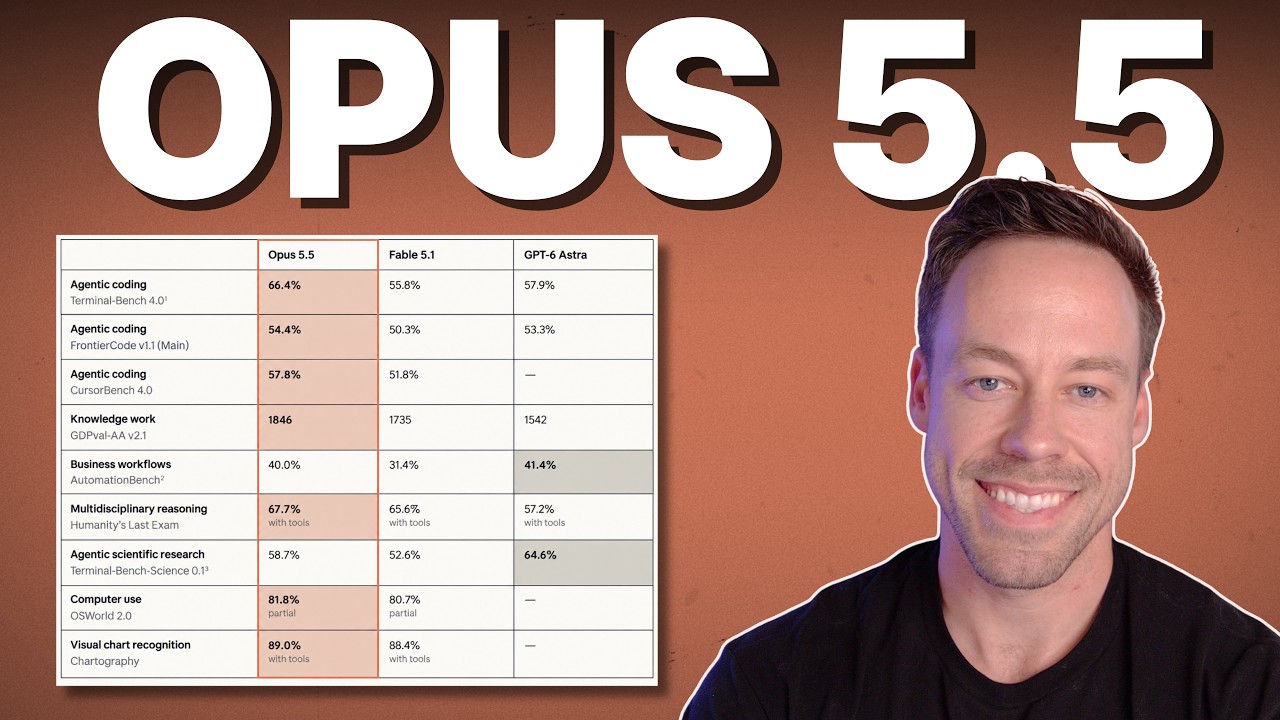
Across the board, Fable 5.1 beats Fable 5, Opus 5, and GPT 5.6 Soul at literally everything. Some of the jumps are significant:
- Agentic science / scientific research — roughly double what Fable 5 scored.
- Agentic coding — from 42% on Fable 5 to 55.8% on Fable 5.1. That's a real leap, not a rounding error.
- Business workflows (Automation Bench) — one of the standout gains beyond the incremental improvements elsewhere.
Most of the other benchmark increases are incremental — a few percentage points here and there. But here's the honest framing: when Opus 5 launched, the raw numbers blew everyone away, yet most people still preferred Fable 5 to Opus 5 in real use. The Fable 5 versus 5.1 comparison is a more accurate signal of what it'll actually feel like when you're working. Benchmarks are directional; the day-to-day feel is what you're really buying.
Should You Use Max Effort, or Is Medium Enough?
This is the most useful part of the whole release, and most people are going to miss it. The benchmark score alone doesn't matter — what matters is how much you're paying for that score, and what happens when you change the effort level.
Here's the pattern that shows up over and over: you don't get much extra output going from high to extra high to max, but you pay a lot more for it.
Look at Terminal Bench 4.0. Ranking from top to bottom it's Mythos 5.1, then Fable 5.1, then Mythos 5 (with Fable 5 sitting just below Mythos 5). Both 5.1 models are a big jump over Mythos 5 — and cheaper. But watch the effort levels:
- Medium on Fable 5.1 matches the max output of Mythos 5 — except it costs $7.80 instead of $26.
- Going from high to max buys you about a 6% change in output, yet costs $19.50 versus $10.50.
The same story plays out on Humanity's Last Exam — no huge jump from high all the way to max, but strong performance at reasonable cost on the middle-tier settings.
The one exception is Agentic Coding on Cursor Bench, where Fable 5.1 does show a real jump from high to extra high. But even there, extra high to max barely moves. And here's the kicker: high on Fable 5.1 matches extra high on Fable 5 — at less than half the cost.
The takeaway: you can get extremely high performance at middling effort levels and save a ton of money. Personally, I sit on medium for most of my Fable use cases and high when I need it. If you're an average solo dev whose problems aren't wildly complex but you like using frontier models, just drop the effort level down. You're doing what you were doing before at roughly half the cost.
Did the Safety Guardrails Change?
Yes, and this one's a quiet win. The original Fable 5 had a habit of throwing false positives — ask a question about cybersecurity and it would freak out and refuse or bump you to a different model. Fable 5.1 fixes a lot of that.
- 60% fewer false positives overall.
- Claude Code users can expect about 60% fewer safeguard interventions per session specifically on cybersecurity questions.
The guardrails are more precise now — less likely to flag benign content and demote you to a lower model. If you build anything where you legitimately need to ask about security best practices for your use case, this removes a real day-to-day annoyance.
If you want the deep detail, the system card is public — all 212 pages of it — but the summary is simple: more precise guardrails, fewer dumb refusals.
What Are the Anti-Distillation Mechanisms?
There's an interesting section on anti-distillation — methods to stop people from extracting the best of Fable 5 and Fable 5.1 to train other models. This is a big topic in the open-source world right now.
You've probably seen the wave of strong open-source models coming out, many of them from China, while the frontier labs sit mostly in the US. There's a persistent argument that a lot of those open-source models are effectively distilled from frontier models like Opus and Fable. The example given: new API accounts can't edit Claude's prior context to reverse-engineer how it thinks and reaches its answers.
Here's the practical part — this only applies to new accounts. If you already have one, it won't affect you. It's more of a meta industry story to keep an eye on than something that changes your workflow.
What Else Changed?
A couple of smaller notes worth knowing:
- Data retention policy — being updated and phased in for enterprise customers.
- Scientific research — still a major selling point (molecular design, computational analysis and modeling, computational biology), with no changes in 5.1. Niche for most people, but interesting to watch alongside the standard coding benchmarks.
- Availability — it's available everywhere right now.
Is Fable 5.1 Worth Switching To?
Short answer: yes. It's better, it's cheaper, and you have to fight the guardrails less. I loved Fable 5 — it was the one for me even over Opus 5 — and if you've been hands-on with Fable, you know it brings something meaningfully different from the rest of Anthropic's lineup. Getting a version that's stronger on benchmarks and cheaper to run is exactly the kind of upgrade you want.
Frequently Asked Questions
How much cheaper is Fable 5.1 than Fable 5?
An estimated 25% cheaper on normal tasks and up to 45% cheaper on long-running agentic workloads. The per-token price is unchanged ($10 per million input, $50 per million output) — the savings come entirely from cache reads costing 75% less.
Does Fable 5.1 beat Opus 5?
On benchmarks, yes — Fable 5.1 beats Fable 5, Opus 5, and GPT 5.6 Soul across the board. But in real-world use many people already preferred Fable 5 to Opus 5, so the more meaningful comparison is Fable 5 versus 5.1, where the improvement genuinely shows up in daily work.
What effort level should I use with Fable 5.1?
Medium or high for most work. The benchmarks show you get very little extra output going from high to extra high to max, while the cost jumps sharply. Medium on Fable 5.1 can match the max output of Mythos 5 at a fraction of the price.
Did Fable 5.1 fix the false-positive refusals?
Yes. It has 60% fewer false positives overall, and Claude Code users can expect about 60% fewer safeguard interventions per session on cybersecurity questions. The guardrails are more precise and less likely to demote benign requests to a lower model.
Is Fable 5.1 available now?
Yes, it's available everywhere right now.
If you want to go deeper into getting the most out of frontier models like Fable 5.1, join the free Chase AI community for templates, prompts, and live breakdowns. And if you're serious about building with AI, check out the paid community, Chase AI+, for hands-on guidance on how to make money with AI.