GPT-6 Astra vs Fable 5.1: What Actually Matters
GPT-6 Astra vs Fable 5.1: What Actually Matters
OpenAI's GPT-6 Astra matches or beats Anthropic's Fable 5.1 across nearly every benchmark, and it does it for less money. Right after Anthropic dropped Fable 5.1, OpenAI struck back with Astra — and the headline isn't the raw scores. It's that Astra hits roughly the same accuracy at a fraction of the cost. I went through the full benchmark set and the new features so you don't have to. Here's what's real, what's hype, and what you should actually care about if you're building with these models.
Is GPT-6 Astra Better Than Fable 5.1?
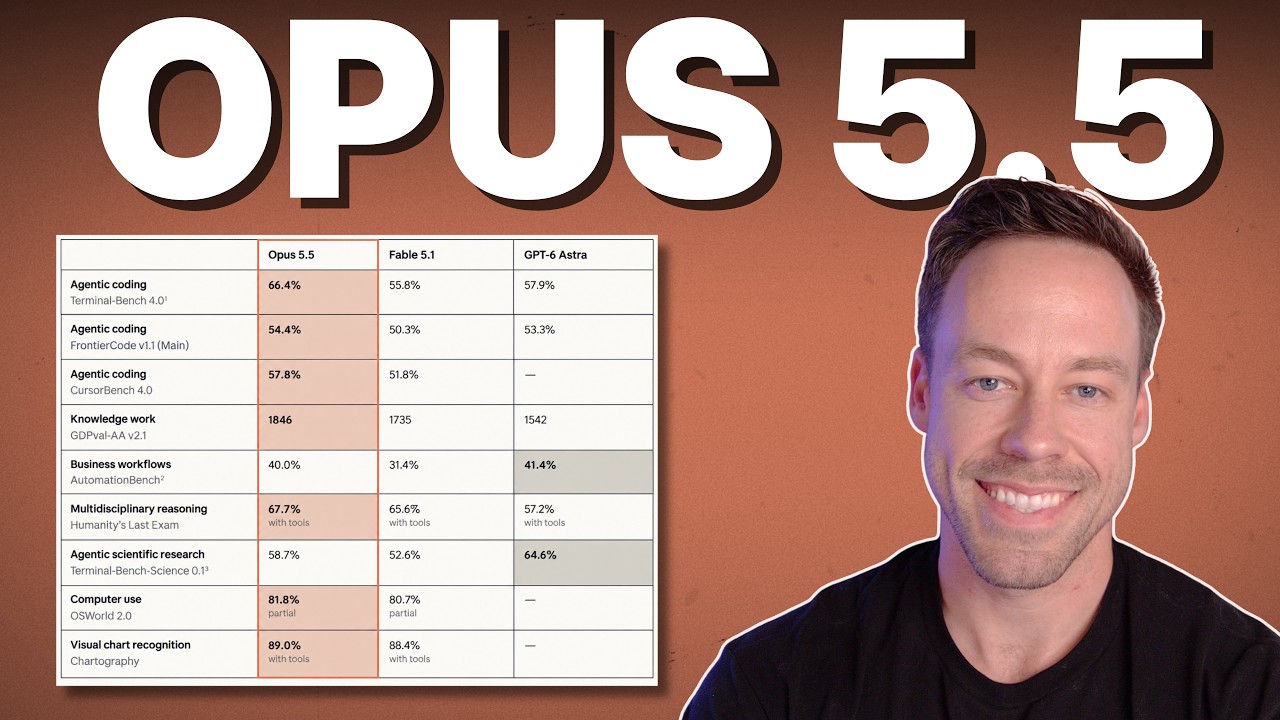
On most benchmarks, yes — and where it isn't, it's usually close. OpenAI gave us a lot more benchmark data than Anthropic showed with Fable 5.1, which already tells you something about how confident they are.
On computer use, Astra basically runs the table. On professional benchmarks like Bench CAD and Browse Comp, it wins again. The one place Fable 5.1 comes out ahead is the Artificial Analysis Intelligence Index, where it scores 65.7 to Astra's 61.2. That's the exception, not the rule.
Here's the thing: a single "which is smarter" number was never the interesting question. The interesting question is what you get per dollar, and that's where Astra separates itself.
How Does GPT-6 Astra Perform on Coding Benchmarks?
Coding is where a lot of you live, so this matters. On coding, Astra is either beating Fable 5.1 or running neck and neck.
The standout is Terminal Bench 4.0. Astra jumps from GPT-5.6 Soul's 37.3 all the way to 57.7 — a huge leap generation over generation. On the DeepSeek coding benchmark, which focuses on long-running agentic tasks, Astra scores 74.1%, better than everything else out there right now. If your work looks like long agent runs rather than one-off completions, that number is the one to watch.
Academic, science, and health benchmarks? Astra crushes those too. The pattern is consistent enough that the exceptions are what stand out.
What Are the Cybersecurity and Long-Context Numbers?
Cybersecurity is where the generational jump gets almost silly. Compared to GPT-5.6 Soul, Astra goes from 70.5% to 100% on one benchmark, from 55.9% to 88.5% on another, and up to 39% on the exploit bench. This is a step change from the entire 5 series, not an incremental bump.
Long context is just as strong. Astra scores a perfect 100% on the eight-needle test from 256k to 512k tokens — a quarter of the window up to a completely full one. Push the window from 512,000 tokens to a full million and it still scores 96.3%. If you're the kind of builder who throws massive context at your model — whole codebases, long transcripts, giant docs — Astra holds up where a lot of models fall apart.
Is GPT-6 Astra Cheaper Than Fable 5.1?
This is the part that actually changes decisions. The best score in the world doesn't matter if it costs 10x everything else. GPT models have historically been very token efficient, and Astra keeps that going.
Look at Terminal Bench 4.0 with cost factored in. First, a note that applies to almost every model here: you see efficiency drop as you climb the effort ladder. Going from low to medium to high, you get better scores at a roughly linear cost increase. But go from high to extra-high to max, and you can actually get a worse score at a higher cost. More money, less accuracy. Max effort is not automatically the right setting.
Now the head-to-head:
- GPT-6 Astra on high: 57.9% accuracy for $7.21
- Fable 5.1 on high: 49.4% accuracy for $10.50
- Fable 5.1 on max: 55.8% accuracy for $19.50
Read that again. To hit roughly 55% accuracy, Fable costs almost $20 per run. Astra hits basically the same number for $7.20. That's not a rounding difference — it's night and day on your bill. The same pattern shows up on Frontier Code 1.1, where the high-end scores are similar but Astra is far cheaper to run thanks to token efficiency. In one Frontier Code case Fable 5 actually scored higher, but you pay a steep premium for it.
On API pricing, Astra actually matches Fable: $10 per million input tokens and $50 per million output tokens. So the sticker price is the same — the savings come from Astra burning fewer tokens to get to the same answer.
What New Features Does GPT-6 Astra Add?
Benchmarks aside, OpenAI is calling out a few functional wins that matter in day-to-day work.
It's the world's best computer use model. On benchmarks that test this — like the ASI-style exam — Astra crushes it on both accuracy and API cost. But the sleeper feature is speed. Astra is about 1.9 times faster than GPT-5.6 at computer use, which is a big deal if you've been running Codex with voice mode over the last month. Accuracy matters, but speed is what makes computer use actually usable.
Template adherence got a lot better. Give Astra a slide deck as a template and ask for a new deck on a different topic, and it holds the style tightly. Same story with Excel documents and general document styling — hand it a reference image and the output matches. If you've got a template you reuse constantly — a design system for slides, docs, or websites — this is where Astra shines.
They claim it has better taste. OpenAI says Astra brings stronger visual judgment to websites, games, applications, and rendered builds. You've heard "AI has no taste" a hundred times — they're pushing back on that with examples like an Unreal Engine walkthrough, Blender modeling, and a set of still images. Be honest with yourself here, though: give any model a bad prompt and you get regression to the mean, and people will blame "AI" for that mean no matter how good the model actually is. Better taste is real, but it's not a substitute for a good prompt.
How Does Astra Handle Context Window Compaction?
This is my favorite change, and it's easy to miss. Normally, when you fill up a context window, the model auto-compacts — it writes a single summary of the session and starts fresh. The problem is obvious: a one-shot summary leaves things out, and if a detail didn't make the cut, it's gone.
Astra keeps notes across context windows instead of collapsing everything into one summary. Think of it as a stack of sticky notes about what it decided was important, any of which it can reference later — rather than one "here's the summary, hope this is everything" document. On top of that, earlier context windows stay searchable, so a missing detail isn't a dead end anymore.
One catch: this is experimental for now. You have to enable it in the Codex config, but OpenAI says it'll become the default in a few weeks.
What About Safety and Hallucinations?
On cybersecurity, Astra follows the same posture Anthropic takes with Fable: the model is powerful enough to write real exploits, so if it thinks you're trying to build one, it just won't. It won't hear the prompt, won't answer. Expect the same kind of guardrail you already know from Fable.
The bigger practical win is hallucination rate. The 5.6 models — and the 5 series in general — hallucinated noticeably more than other frontier models. Astra drops the head-to-head hallucination rate from around 9.4% down to 2%. That's the kind of improvement you feel in real work, not just on a chart.
When Can You Use GPT-6 Astra?
Right now it's open to a limited set of organizations, and it rolls out to essentially everybody in the next few days. The API is already available for developers at the pricing above — $10 per million input tokens, $50 per million output tokens.
Based on the numbers, OpenAI shipped a model that genuinely competes with the best Anthropic has, and it's doing it at a better effective price. That's the real story: not that one lab "won," but that having the biggest players trading blows every few weeks is exactly what you want as the person building on top of them.
Frequently Asked Questions
Is GPT-6 Astra better than Fable 5.1?
On most benchmarks, yes. Astra wins or ties on computer use, coding, cybersecurity, and long context, and it does it at a lower effective cost. The main exception is the Artificial Analysis Intelligence Index, where Fable 5.1 scores 65.7 to Astra's 61.2.
How much does GPT-6 Astra cost?
API pricing matches Fable: $10 per million input tokens and $50 per million output tokens. The real savings come from token efficiency — on Terminal Bench 4.0, Astra hits ~55% accuracy for about $7.20 versus almost $20 for Fable at the same score.
Should I always run Astra on max effort?
No. On benchmarks like Terminal Bench 4.0, accuracy can actually drop while cost rises when you go from high to extra-high to max. High effort is often the sweet spot for cost and accuracy — test your own workload before defaulting to max.
What is Astra's new context compaction feature?
Instead of collapsing a full context window into a single summary, Astra keeps multiple notes across windows and leaves earlier windows searchable. It's experimental for now — you enable it in the Codex config — but OpenAI says it will become the default within a few weeks.
Is GPT-6 Astra available yet?
As of now it's open to a limited set of organizations, with a wider rollout to everyone expected within days. The API is already live for developers.
If you want to go deeper into building with the latest AI models, join the free Chase AI community for templates, prompts, and live breakdowns. And if you're serious about building with AI, check out the paid community, Chase AI+, for hands-on guidance on how to make money with AI.