Astra 6.2 vs Fable 5.2: Is the Astra Hate Real?
I ran OpenAI's Astra 6.2 against Fable 5.2 across five real build tests. Fable won four of five, usually big — but Astra is 4-5x cheaper. Here are the numbers.
Want to learn Claude Code?See the Claude Code Masterclass
On this page
The short answer: mostly yes. I ran OpenAI's Astra 6.2 head-to-head against Fable 5.2 across five real build tasks — game design, web design, 3D, motion graphics, and video editing — and Fable won four of them, usually by a wide margin. Astra is cheaper and faster almost every time, but on open-ended creative work it gets lazy and quits early. Here's exactly what happened in each test, with the real cost and token numbers.
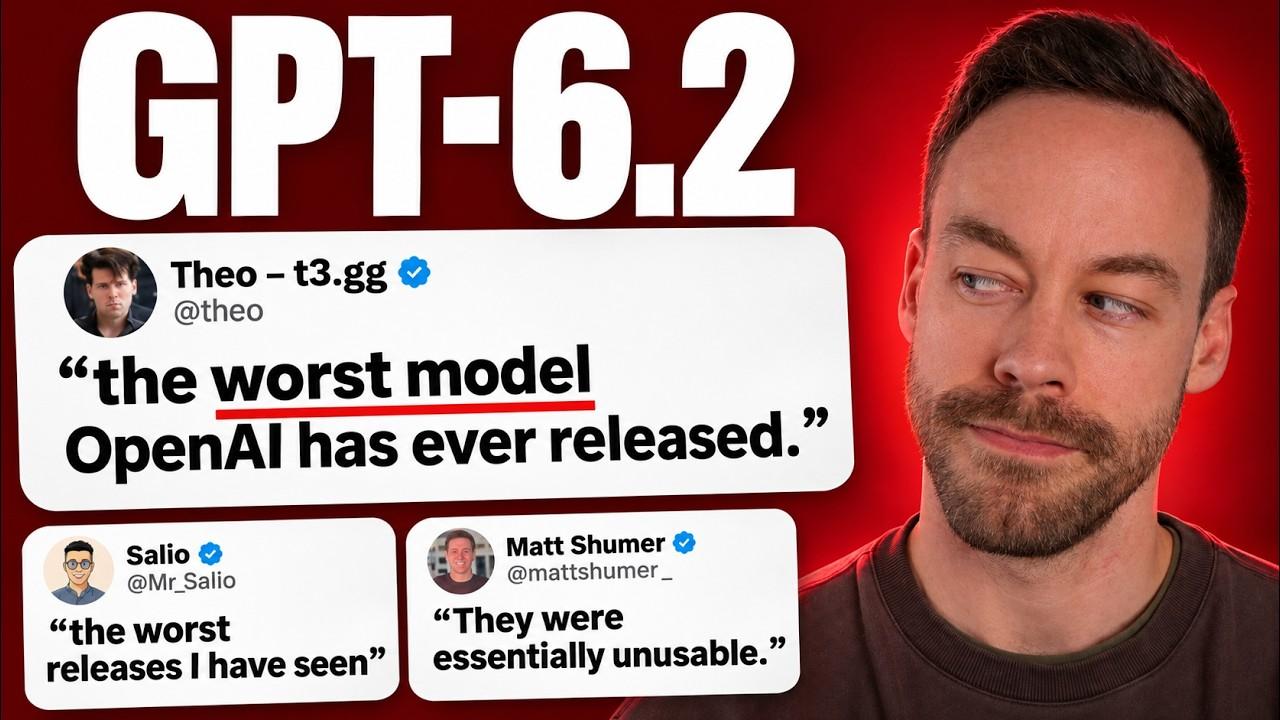
If you've been on social media since the Astra 6.2 and Soul 6.2 launch, you've seen the pile-on: "unusable," "worst releases I have ever seen," "horrible at communicating, quite lazy," "the worst model OpenAI has ever released." That reaction is strange at first, because the benchmarks tell a very different story. So I stopped reading takes and ran the tests myself.
What Do the Astra 6.2 Benchmarks Actually Say?
On paper, Astra 6.2 looks like a model nobody should be complaining about. The numbers are genuinely competitive with Fable 5.2 — and in some categories Astra wins.
On the independent tests from Artificial Analysis, it's near-parity: Astra won three, Fable won four. Astra actually took some of the coding benchmarks, beating Fable on Terminal Bench 4.0 by 4.7 points. On the overall Artificial Analysis Intelligence Index, Fable 5.2 pulled ahead — but only 62.1 for Astra versus 64.6 for Fable, not some blowout.
OpenAI's own numbers are, predictably, more flattering. On Agents' Last Exam, Astra 6.2 scored 78.3 versus Fable's 72.8 — and the cost gap is wild: that run cost Astra $2.89 against Fable's $60.05. On their coding benchmark, Frontier Code 2.0, Fable won by a solid margin (49.1 to 44.2).
The efficiency story is the headline. Across cost-per-task and time-per-task, Astra was cheaper and faster at both high and max effort: roughly $2 vs $9, 5 minutes vs 14 minutes, 10 minutes vs 40 minutes. Take all of that at face value and you'd conclude Astra is a slight step below Fable on raw quality but far more efficient. So where's the hate coming from?
Why Does Everyone Say Astra 6.2 Feels Lazy?
The hate isn't really about benchmarks — it's about vibes. It's how the model feels to work with, how it communicates, and how much it actually tries when you hand it an open-ended goal. Those things don't show up on a graph, and they're exactly what my five tests exposed.
Here's the pattern that emerged: when you give Astra a clear end-state and a lot of room to get there, it under-delivers and stops early. Give it tighter guidance and references, and it's genuinely solid. That distinction matters more than any single benchmark.
Test 1: Who Builds a Better Game — Astra or Fable?
I used /goal for both models with a 2-hour cap and a deliberately loose prompt: create a AAA shooter where three little pigs defend their homes from wolves. I kept it simple on purpose — I wanted to see each model's judgment and creativity, not just its ability to follow a checklist. (The prompt was inspired by Anthropic engineer Nate Perrit, who ran the same idea when Fable first launched.)
Astra 6.2 gave me a flat 2D point-and-click with three defense sectors — Straw House, Stick House, Stone House — and that was basically it. It called itself done in 28 minutes, less than a quarter of the time it was given, and generated only five images. For a prompt that said "AAA," it was the definition of lazy.
Fable 5.2 built "Pork and Mortar" — a far more polished game with a settings bar, multiple graphics qualities, three playable pig brothers you can switch between, each with their own weapons (a Splinter Shatter Gun, a bright cannon, a grenade launcher), upgrade choices, sound, and camera control. It used nearly the full two hours and generated 45 images (I gave Fable access to Soul for image generation to keep things fair).
The numbers: 28 minutes and $2.66 at 2.6 million tokens for Astra, versus roughly 1 hour 53 minutes and about 10x the cost and tokens for Fable. Fable spent an order of magnitude more — and delivered something an order of magnitude better. No contest.
Test 2: Which Model Designs a Better Web Page?
Next I asked both to build a landing page for a fictional SaaS called Margin, a bookkeeping app for freelancers. Critically, I told them not to use any front-end design skills — I wanted to see each model's raw, baseline design taste.
Astra's output was boring: rounded corners, a pink-purple gradient slapped on immediately, a weak hero image, and an overall "AI slop" feel. Coming from the earlier Astra 6 web tests, this felt like a step backwards.
Fable 5.2 wasn't blowing anyone away either, but it clearly tried: motion design on load, elements popping onto the screen, subtle mouse-follow movement, a ticker, a Trustpilot element. Little touches that add weight and attention to detail. It still looked AI-built — but the gap was night and day.
On efficiency, Astra won again: 13 minutes versus Fable's 52. But as I put it in the video — if you're faster and cheaper but the output is mediocre, I don't care. If I wanted cheap-and-fast mediocre, I'd reach for a smaller open-source model, not OpenAI's flagship.
Test 3: Can Astra 6.2 Handle 3D Work?
This was supposed to be Astra's category. 3D is one of the few areas Astra usually gets praised for, so I expected it to shine. The prompt: build an interactive turbo-fan engine explainer, entirely in code.
Astra delivered a legitimately okay result — a cutaway view, zoom in and out, an exploded view, clickable components (bypass, combustion, turbine), a throttle control, and airflow you could follow, with a little explainer panel at the bottom. Not awful. Not wowing me either.
Fable 5.2 did more: a nicer opener with motion, a cutaway, an X-ray view, exploded view, a "ride the air" mode that traces airflow through the engine, plus a live readout of temperature, pressure, speed, and streams that changed with each component you clicked. Clearly better, and this time Fable didn't even work 10x as long — Astra took 41 minutes and still came up short in a category it's supposed to own.
Cheaper and faster yet again, sure. But three tests in, the question writes itself: efficient for what? If I'm reaching for a flagship model, I want to be wowed — and I was only wowed by Fable.
Test 4: Which Model Makes a Better Code-Only Explainer Video?
I asked each model to create a 30-second explainer video in pure JavaScript — no image generator, all code — explaining how a new large language model gets built, and told them to be creative.
Astra's version was honestly decent. The voiceover was weak (I didn't hand it any external audio tooling), but the visuals walked cleanly through gathering and filtering text, tokenizing, next-token prediction, training on thousands of chips, instruction tuning, RLHF, and safety testing. Solid for a raw prompt.
Fable's version I liked better: more motion, more energy, better color, a sense of distinct beats telling a story rather than the same green palette throughout. It felt dynamic where Astra felt static.
The cost gap was the biggest of the whole test: Astra ran about $3 at 2.9 million tokens; Fable ran about $23 at 34.1 million tokens, and Fable spent far longer (roughly 1 hour 53 minutes plus 5 minutes for a voiceover pass, versus Astra's 17 minutes plus 16). The pattern is now obvious — hand Astra an open-ended "go make something awesome" prompt and it does the bare minimum.
Test 5: Is Astra 6.2 Good at Video Editing?
This is the one Astra won — and it's the exception that explains everything. I handed both models the raw first 30 seconds of a recent video (the hook from my "Claude Code plugins that are slowing you down" video), told them to edit it in Hyperframes, and said go nuts.
Both were genuinely good. I'd honestly put either edit on par with — or better than — the version I actually published. I'd give a slight, subjective edge to Fable, but they were about even on quality. And on efficiency Astra took it cleanly: $7 and 48 minutes versus Fable's $11.50 and 1 hour 34 minutes. With quality roughly tied, the faster, cheaper model wins the edit.
Here's the key difference: for this task I gave Astra a specific style reference — the colors, vibe, and feel to build on. The first four tests gave it almost nothing. When Astra had something concrete to build upon, it delivered a result on par with Fable. When it had only an open-ended goal, it checked out.
Astra 6.2 vs Fable 5.2: The Final Numbers
Add up all five tests and the resource gap is enormous:
- Total time: Astra ~2.5 hours vs Fable ~7.5 hours
- Total cost: $18.11 for Astra vs $86.63 for Fable
- Total tokens: 22 million for Astra vs 94.9 million for Fable
So Astra is dramatically cheaper and faster. But with one exception — the video edit — this was a rough showing. The three-little-pigs game was the microcosm of everything wrong with the model: a flagship that quit after 28 of 120 allotted minutes and handed back something lame.
The real takeaway is about prompting style, not raw capability. Give Astra 6.2 steps A through F and a clear reference, and it executes well and cheaply — that's Sonnet's and Terra's job, and Astra does it fine. But the best flagship models are supposed to shine on the open-ended stuff: "I don't know how to get from A to B, but I know what B should look like — go." That's where Fable 5.2 delivers and Astra falls apart.
Disappointing is the honest word for it. And it's a shame, because weak competition isn't good for anyone — right now, for this kind of open-ended agentic work, it's Fable 5.2 and nobody else.
Frequently Asked Questions
Is Astra 6.2 worse than Fable 5.2?
On open-ended creative and agentic tasks, yes — Fable 5.2 won four of five head-to-head build tests, often by a wide margin. Astra 6.2 is meaningfully cheaper and faster (about $18 vs $87 total across the tests), but it tends to stop early and under-deliver when given loose, goal-only prompts.
Why do people say Astra 6.2 is lazy?
Because it quits before fully using the time and resources it's given. In the game test it declared itself done after 28 minutes of a 2-hour cap and produced a minimal 2D result. The "laziness" shows up specifically on open-ended prompts where the model has to supply its own judgment and ambition.
What is Astra 6.2 actually good at?
Efficiency and well-scoped work. It was cheaper and faster in nearly every test, and it won the video-editing task outright. The common thread: when Astra gets a concrete style reference or step-by-step guidance, it produces solid results — it struggles mainly when the prompt is wide open.
How much cheaper is Astra 6.2 than Fable 5.2?
Across all five tests combined, Astra cost $18.11 versus Fable's $86.63 — roughly 4-5x cheaper — and used 22 million tokens versus Fable's 94.9 million. On individual benchmark tasks the gap can be even larger, like $2.89 vs $60.05 on Agents' Last Exam.
Should I use Astra 6.2 or Fable 5.2 for agentic coding?
For open-ended "go build something great" work, Fable 5.2 is the clear pick today. Reach for Astra 6.2 when the task is tightly scoped, you can hand it clear references, and cost and speed matter more than maximal creativity.
If you want to go deeper into testing and comparing AI coding models, join the free Chase AI community for templates, prompts, and live breakdowns. And if you're serious about building with AI, check out the paid community, Chase AI+, for hands-on guidance on how to make money with AI.
Topicsastra-6.2fable-5.2openaiai-model-comparisonagentic-codingclaude-code