Gemini 4 Neon vs Opus 5.5: Is Google Back?
Google dropped four AI models in seven weeks, and Gemini 4 Neon is the one that matters. I ran five blind head-to-head tests against Opus 5.5. Here's how it actually feels.
Want to learn Claude Code?See the Claude Code Masterclass
On this page
Gemini 4 Neon is the first Google model in roughly nine months that can legitimately go toe-to-toe with Claude Opus 5.5 as a daily driver — and it does it for about 25% less money and in a fraction of the time. I ran five blind head-to-head tests between the two, same prompts, same harnesses, and the honest verdict is this: by the raw numbers they're on par, Opus still has a slight edge on output quality, but Neon wins on speed and cost badly enough that it forces the conversation.
Google has been in the AI wasteland for most of this year. That's over. Here's what I found.
What Are Google's New Gemini 4 Models?
In the last seven weeks Google shipped four different AI models, and the naming is confusing on purpose. Anthropic and OpenAI name by theme — Luna the moon (small), Astra the universe (big), Haiku small, Fable big. Google names its models after elements, and the elements don't map to any obvious logic, so you just have to memorize the tiers.
Here's the cheat sheet:
- Hydrogen — the bottom tier. Think Sonnet or Haiku class.
- Neon — the mid-tier model and the star of this comparison. This is the Opus 5.5 analog.
- Carbon — the strongest one. This is the Fable 5.2 equivalent.
There was also an Argon that launched with some gatekept mystique around it, but it's basically gone now — it collapsed into Carbon. So the lineup you actually care about is hydrogen, neon, carbon.
The weird part? Nobody's losing their mind over Carbon, the flagship. Everyone's hyped about Neon, because Neon is posting better numbers than Carbon in several places while being cheaper and faster. That's the whole story: a mid-tier model punching at flagship weight.
How Does Gemini 4 Neon Compare to Opus 5.5 on Price?
Neon comes in around $3.15, versus Opus 5.5 at roughly $4 input and $20 output. That's about 25% cheaper depending on your token mix — and the gap gets wider on real tasks because Neon tends to finish faster and burn less wall-clock time.
Price is half the pitch. Speed is the other half, and it's the part that actually changed my mind during testing.
Does Gemini 4 Neon Beat Opus 5.5 on Benchmarks?
On Google's own posted numbers, Gemini 4 Neon beats Opus 5.5 almost across the board. The only two benchmarks where Opus wins are the raw coding ones — Terminal Bench 4.1 (65.8 vs 65.2) and Frontier Code 2.0 (47.3 vs 46.2) — and it wins them by a hair, not a mile.
Where Neon pulls ahead meaningfully is graph walks, which is a long-context signal. If you work in very large codebases, Neon's long-context handling might matter more to you than a one-point coding benchmark edge. It even beat Fable 5.2 on Cursor Bench, 65.4 to 61.3, which is genuinely surprising for a mid-tier model against a flagship.
But Google grading Google's homework is worth exactly what you'd expect. So I looked at the independent read.
What Does the Independent Benchmark Say?
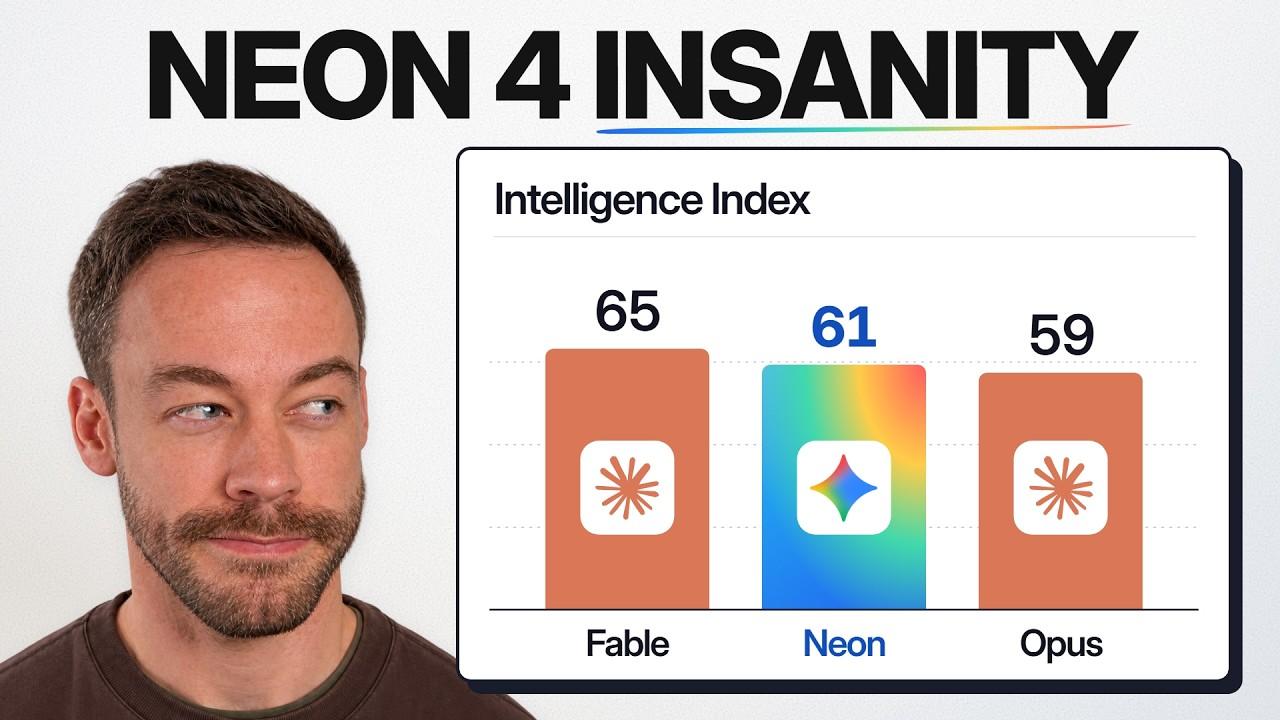
Artificial Analysis runs an Intelligence Index — a catch-all score that folds a bunch of evals into one number. If you don't want to obsess over any single benchmark, this is the one to glance at.
Their current top of the board:
- Fable 5.2 — number one, as expected
- 6.2 Astra (on max settings)
- Gemini 4 Neon — close behind on both its high and extra-high settings
- Carbon
- Opus 5.5
- 6.2 Soul
So an outside grader puts Neon ahead of Opus 5.5 on the composite. Can we fudge the numbers and argue it's basically a tie with Opus? Sure. But "basically tied with Opus while being cheaper and faster" is still a huge result for a mid-tier model. On the index run, Neon finished in roughly 14 minutes for a few dollars, versus Opus at around $10 and 25 minutes. Faster, and a bit cheaper, for a near-identical score.
Numbers only tell you so much, though. The real question is how it feels in your hands.
How Does Gemini 4 Neon Actually Feel? Five Blind Tests
I ran five head-to-head tests, Opus 5.5 versus Gemini 4 Neon, and blind-rated them — I didn't know which output was A and which was B until after I picked. Each model ran in its native harness: Neon through the anti-gravity CLI, Opus 5.5 through Claude Code on high effort. Here's how it shook out.
Test 1 — 3D Turbofan Jet Engine Explainer
I asked for an interactive 3D explainer of how a turbofan jet engine works. Both outputs were genuinely slick — cutaways, thermal and X-ray views, explode controls, a throttle lever, a thermodynamic profile along the bottom. Visually I called it a near-tie with a faint edge to A.
A was Neon. And Neon finished in about 12 minutes while Opus took over an hour, using far fewer tokens. Equal output, way cheaper, way faster — easy win for Neon.
Test 2 — 15-Second Motion Graphics Piece
Prompt: you're a world-class motion designer, you have 15 seconds, make a motion graphics piece about the word "neon." I slightly preferred A again. The opener on B was stronger, but it ran out of steam in the second half, while A had more going on overall.
A was Neon — but this time Neon was the slower one, taking around 42 minutes versus under 30 for Claude, at roughly comparable cost. This was the first test where Neon didn't win on speed, and the outputs were close enough that it barely mattered.
Test 3 — Responsive Web Design
I had each build a polished, responsive homepage for a fictional freelancer bookkeeping app called "margin." This was the clearest Opus win of the five. A felt more designed; B leaned into the telltale AI look — rounded eyebrow pills, a floating green circle, italicized hero text.
A was Opus. The strange part: Opus reportedly took two hours and 3.2 million tokens, which I don't fully buy — something got it stuck, and I wouldn't over-index on that run. Neon knocked it out in 16 minutes for about half the cost. But on the actual output, I still picked Opus, and I'd pay a couple extra dollars for the better site.
Test 4 — Video Hook Editing
I fed each model the first 30 seconds of a real video and told it to edit the hook. Both came back clean — honestly, I'd have been happy shipping either one as the opener to an actual video. Call it a tie on quality.
Neon came in at roughly half the time and a little cheaper. When I'm editing and iterating, waiting matters, so I'd nudge this one to Neon purely on turnaround.
Test 5 — SVG Mechanical Watch
The classic version of this test is "a pelican riding a bicycle" — pure code, no image generators — and it exposes a real gap between old and new models. I swapped in a mechanical watch: working gears, a speed control, sapphire and X-ray views, all drawn in code. Both outputs were on par, slight edge to B.
The separator was speed again: Neon finished in 16 minutes versus 52 for Opus, with a fraction of the tokens. Edge to Neon.
So Should You Switch From Anthropic to Google?
Short answer: probably not — but you should start paying attention to Google again.
Across all five tests, Gemini 4 Neon is a real Opus 5.5 competitor. All else being equal, I slightly prefer Opus 5.5's outputs. But all else isn't equal — Neon is faster and cheaper, sometimes dramatically so. That's a genuine tradeoff, not a blowout in either direction.
I'm not abandoning Anthropic. I use Claude Code every single day, I'm comfortable in it, and I'm not moving my whole workflow into anti-gravity to save a few bucks and a few minutes. Most people watching won't either.
But here's what actually matters: if this is what Google can do with its mid-tier model, what happens when Carbon matures? Neon beating Opus-class work at mid-tier pricing is a signal. The next time Google ships something that genuinely tops Fable or Astra, a lot of us will be primed to bring it back into the stack. After nine months of nothing, Google is back in the game — and more competition for Anthropic is good for everyone. You can try Neon cheaply in Google AI Studio if you want to feel it for yourself.
Frequently Asked Questions
What is Gemini 4 Neon?
Gemini 4 Neon is Google's mid-tier model in the Gemini 4 family, positioned as the equivalent of Claude Opus 5.5. Despite being mid-tier, it posts benchmark numbers competitive with — and in some cases ahead of — flagship models, while costing less and running faster.
Is Gemini 4 Neon better than Claude Opus 5.5?
It depends on what you weight. On Artificial Analysis's independent Intelligence Index, Neon ranks ahead of Opus 5.5. In hands-on blind tests, Opus 5.5 produced slightly better output on average, but Neon was consistently faster and cheaper. For raw quality, Opus edges it; for speed and value, Neon wins.
How much does Gemini 4 Neon cost?
Gemini 4 Neon comes in around $3.15, versus roughly $4 input and $20 output for Opus 5.5 — about 25% cheaper depending on your token mix, and often more in practice because Neon finishes tasks faster.
What are the Gemini 4 model tiers?
Google names its Gemini 4 models after elements. Hydrogen is the bottom tier (Sonnet/Haiku class), Neon is the mid-tier (Opus 5.5 class), and Carbon is the flagship (Fable 5.2 class). An earlier Argon model was folded into Carbon.
Should I switch from Claude to Gemini 4 Neon?
For most workflows, no — Opus 5.5 still has a slight quality edge and switching harnesses isn't worth a small cost savings. But Neon is worth testing, especially for large-codebase and long-context work where its graph-walk performance stands out. You can try it cheaply in Google AI Studio.
If you want to go deeper into AI models and coding agents, join the free Chase AI community for templates, prompts, and live breakdowns. And if you're serious about building with AI, check out the paid community, Chase AI+, for hands-on guidance on how to make money with AI.
Topicsgemini-4-neonopus-5-5ai-modelsgoogle-geminibenchmarksai-coding