Claude Fable 5.2: Cheaper, Faster, Stronger
Anthropic's Fable 5.2 and Mythos 5.2 are better, faster, and cheaper than 5.1 — here's how they stack up against Opus 5.5 and whether you should switch.
Want to learn Claude Code?See the Claude Code Masterclass
On this page
Anthropic just shipped Fable 5.2 and Mythos 5.2, and the headline is simple: they're better, faster, and cheaper than the 5.1 models they replace. Outputs are up to 30% faster, input and output prices both dropped, and the benchmarks beat Opus 5.5 almost across the board. I've been running Opus 5.5 as my daily driver since it launched, so this is the first model in a while that actually makes me want to switch. Here's everything that changed and whether it's worth moving over.
What Is Claude Fable 5.2?
Fable 5.2 and Mythos 5.2 are Anthropic's latest flagship model release, succeeding the 5.1 generation. They're essentially the same underlying model with one difference: Fable ships with more guardrails than Mythos, specifically around biology, chemistry, and cybersecurity topics.
Which one you get depends on your plan. Regular users don't get Mythos — if you're on a Max plan, you get Fable. So for most paying customers, Fable 5.2 is the model you'll actually be using day to day.
The short version: this is a mid-cycle upgrade that moves the needle on every axis that matters — speed, price, and raw capability — without asking you to change how you work.
How Much Faster and Cheaper Is Fable 5.2?
This is where the release earns attention. Fable 5.2 outputs are up to 30% faster than 5.1, and the price dropped on both ends.
Here's the pricing breakdown:
- Standard: $8 per million input tokens, $40 per million output tokens. That's down from $10 and $50 on the 5.1 generation.
- Fast mode: 2.5x faster outputs at $16 per million input and $80 per million output. You pay double for the speed — as the saying goes, fast mode is for people who hate money, but the option is there when you need it.
A model that's simultaneously cheaper and faster is rare. Usually you trade one for the other. Getting both in the same release, plus a capability bump, is the kind of upgrade that quietly changes your defaults without you thinking about it.
Is Fable 5.2 Better Than Opus 5.5?
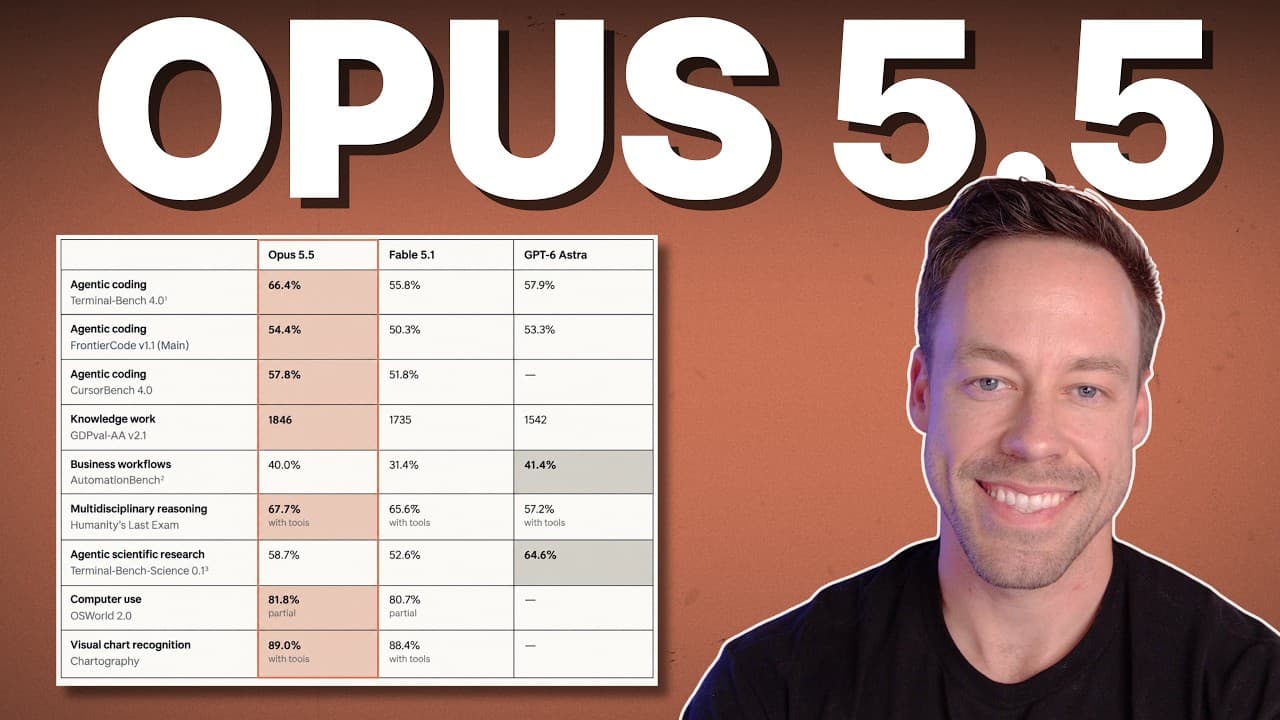
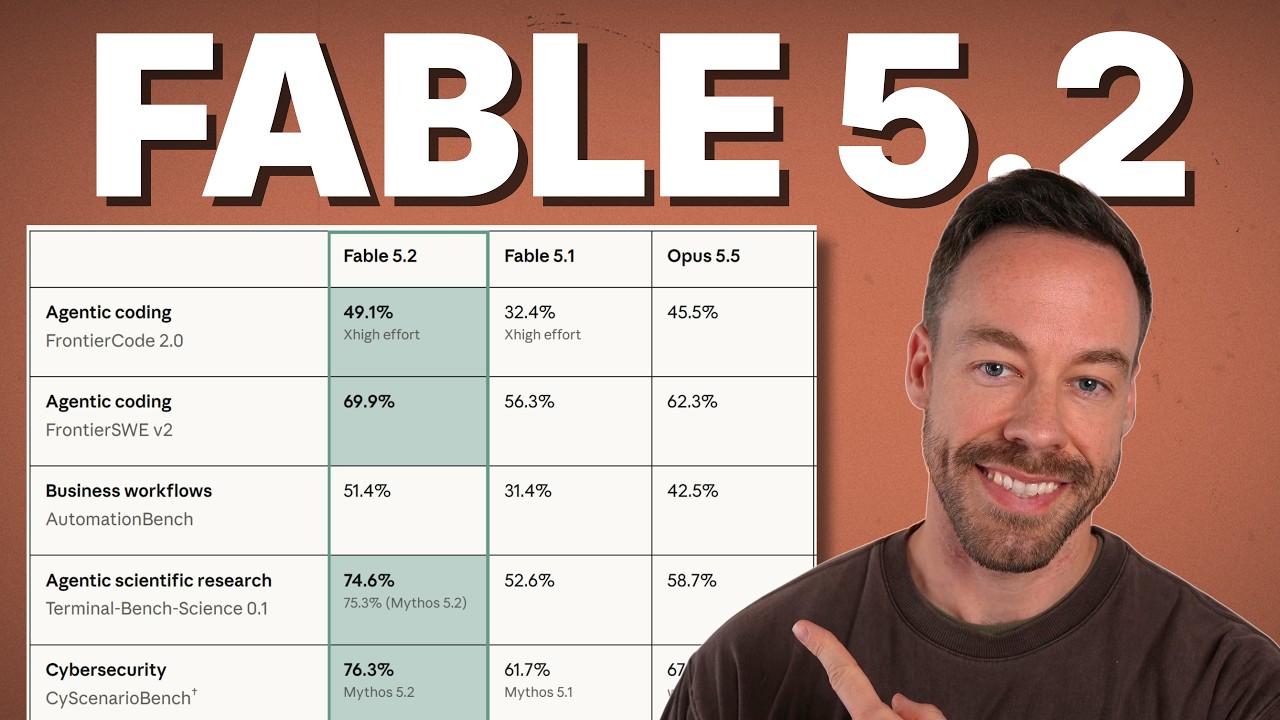
Yes — Fable 5.2 beats Opus 5.5 on nearly every benchmark, with the one real exception being knowledge work. On that category the two are basically tied: 1,800 for Fable 5.2 versus 1,785 for Opus 5.5.
Everywhere else, you're looking at solid, modest gains. Nothing insane, but consistent. A couple of concrete examples from the benchmark set:
- Agent decoding climbs from 45 to 49 on one measure and 62 to 69 on another.
- Compared against the full field — 5.1, Opus 5.5, GPT-6 Astra, and Gemini 4 Carbon — Fable 5.2 sweeps the board except for business workflows and knowledge work.
The biggest jumps over 5.1 show up in agentic scientific research, cybersecurity, and multidisciplinary reasoning. As always, treat raw benchmark numbers with a grain of salt. They tell you the direction of travel, not the full story of how a model feels in daily use. But the direction here is clearly up.
Does Fable 5.2 Actually Cost Less Per Task?
Raw benchmark wins don't mean much if the model burns ten times the budget to get there. The real question is cost efficiency — performance per dollar. Looking at the Frontier Code 2.0 cost-versus-performance analysis tells a more useful story than the leaderboard alone.
At the max effort setting, Fable 5.2 isn't worth it. Opus 5.5 scores roughly 45% at a far lower cost, while Fable 5.2 lands 45.6% at around $44. But here's the thing — almost nobody runs max effort. Most people live on medium and high.
At the high effort setting, Fable 5.2 is a clear win on capability. Opus 5.5 scores 34.5% at $2.42. Fable 5.2 jumps to roughly 45.3% — a significant leap in performance. The cost rises too, from $2.42 to $6.72, so you're paying for that power. The point is the headroom is there when you need it.
And the most interesting finding: Fable 5.2 on the low setting delivers roughly the same output as Opus 5.5 on high — at a lower price. That's the sweet spot. If you've been paying for Opus 5.5 on high, you may be able to drop down to Fable 5.2 on low, keep the quality, and spend less.
What's the Big Deal With Robotics?
The one niche Anthropic specifically calls out as a huge leap is robotics. On the Robo Dojo benchmark — simulated control of a two-armed robotic machine — Fable 5.2 jumps from Opus 5.5's 39.4 all the way to 64.9 at max effort.
That's not a modest gain. That's a different tier of capability. If you're building anything that touches physical control, simulation, or embodied agents, this is the single most meaningful number in the release. Most people reading this won't be doing robotics work, but it signals where Anthropic is pushing the frontier.
Did Anthropic Fix the Over-Blocking Problem?
If you've ever had a legitimate question get blocked or silently routed to a dumber model because it brushed up against a safety guardrail, this release is aimed at you. Anthropic says Fable 5.2 triggers its guardrails far less often than 5.1.
The safety architecture itself is familiar. When a query gets blocked, it still gets routed to a smaller model: cybersecurity questions go to Opus 4.8, and biology-related questions get pushed down to Opus 5. The improvement is in how often that happens.
According to Anthropic's testing, you should see:
- Roughly 55% fewer blocks overall
- 60% fewer cybersecurity triggers
- 40% fewer biology triggers
In plain terms: fewer legitimate questions bouncing off the guardrails and landing you on a less intelligent model. That's a real quality-of-life win if your work lives anywhere near those topics.
Where Can You Use Fable 5.2 and What Are the Limits?
Good news — Fable 5.2 is available everywhere right now. No staged rollout to wait on.
Depending on how long you've been on a plan that includes Fable usage, you may also get one to three Fable usage resets, which is a nice bonus for long-time subscribers. The one thing that didn't change: Fable still only counts up to 50% of your weekly usage limits. That cap has been constant across releases. But combined with up to three resets, there's real room to put the model through its paces without hitting a wall immediately.
Should You Switch to Fable 5.2?
If Opus 5.5 has been your daily driver, Fable 5.2 is an easy upgrade to test. It's better on nearly every benchmark, cheaper per million tokens, up to 30% faster, and it blocks your legitimate questions less often. The only category where it doesn't clearly win is knowledge work, where it's a tie.
The smartest move is to run Fable 5.2 on a lower effort setting first and see if the output matches what you were getting from Opus 5.5 on high. If it does — and the cost analysis suggests it will — you keep your quality and cut your spend. That's the kind of upgrade worth switching for.
Frequently Asked Questions
What's the difference between Fable 5.2 and Mythos 5.2?
They're essentially the same model. The difference is guardrails: Fable ships with more safety restrictions around biology, chemistry, and cybersecurity. Which one you get depends on your plan — regular users don't get Mythos, and Max plan users get Fable.
How much does Fable 5.2 cost?
Standard pricing is $8 per million input tokens and $40 per million output tokens, down from $10 and $50 on the 5.1 generation. Fast mode doubles the price to $16 input and $80 output in exchange for 2.5x faster outputs.
Is Fable 5.2 better than Opus 5.5?
On benchmarks, yes — Fable 5.2 beats Opus 5.5 on nearly every category, with modest but consistent gains. The one exception is knowledge work, where the two are essentially tied (1,800 versus 1,785). The biggest single jump is in robotics on the Robo Dojo benchmark.
Does Fable 5.2 block fewer questions than 5.1?
Yes. Anthropic's testing shows roughly 55% fewer blocks overall, 60% fewer cybersecurity triggers, and 40% fewer biology triggers compared to 5.1. Blocked queries still route to smaller models — Opus 4.8 for cybersecurity and Opus 5 for biology.
Is Fable 5.2 available now?
Yes, it's available everywhere immediately. Depending on how long you've been subscribed to a plan with Fable usage, you may also receive one to three Fable usage resets. Fable still counts up to 50% of your weekly usage limits.
If you want to go deeper into getting the most out of Anthropic's latest models, join the free Chase AI community for templates, prompts, and live breakdowns. And if you're serious about building with AI, check out the paid community, Chase AI+, for hands-on guidance on how to make money with AI.
Topicsclaudefable-5.2anthropicai-modelsopus-5.5